Setting a New Standard for Women’s Health


Reframing women's health spending from indulgence to investment
LYMA came to The Future Laboratory with an ambition to change the way women think about investing in their health.
The opportunity was significant: the global wellness economy is on track to approach £7.3 trillion ($9.8 trillion) by 2029, according to Global Wellness Institute, as spending accelerates across longevity, preventative medicine, diagnostics, beauty and personalised health. Yet, while health is increasingly behaving like an asset class, consumers still lack a meaningful way to judge its return.
To understand that gap, we conducted proprietary research into how women and men value, prioritise and make decisions about their health. The findings revealed a striking contradiction. Women are almost twice as likely as men to describe the same health and wellness spending as an ‘indulgence’ rather than an ‘investment’, while almost two-thirds of women aged 18–45 feel they are expected to age well without being given the tools or information to do so.
 LYMA, UK
 City Circadian Reset by Surrenne at The Emory, London, UK
Our research suggested that the challenge wasn’t convincing women that their health matters – it was giving them greater confidence in what deserves their investment. Here, we identified a growing appetite for more rigorous ways to assess value amid a market saturated with products and claims. The numbers reinforced this shift: clinical proof mattered more than brand cachet across every age group surveyed, rising to 86% among women over 55, while consumers with a stronger preference for science-led beauty and wellness were also prepared to spend more.
This led us to a critical question: if health is going to be treated as an investment, where is the framework for judging its return? Rather than simply encouraging women to spend more on their health, LYMA had an opportunity to give them the tools to spend with greater discernment – to distinguish genuine value from an expensive story.
That insight became the foundation for the LYMA P.O.W.E.R. Index.
Translating research into an ownable framework to cut through the noise
The Future Laboratory worked with LYMA and leading medical experts Dr Florence Comite, Dr Stephanie Kuku and Dr Elissa Epel to create the P.O.W.E.R. Index – a new framework designed to give consumers a more rigorous way to evaluate health investments.
Built around five principles – Proven, Outcomes, Whole-System, Empowering and Return – the Index moves beyond broad claims such as ‘science-backed’ or ‘clinically proven’ to ask harder questions about the evidence, outcomes and long-term value behind a product, service or intervention.
Crucially, the Index was designed not to tell women what to invest in, but to give them a better framework for deciding what is worth investing in for them – transforming the research into an ownable tool that LYMA can use to champion greater proof, accountability and discernment across the health and wellness market.
 City Circadian Reset by Surrenne at The Emory, London, UK
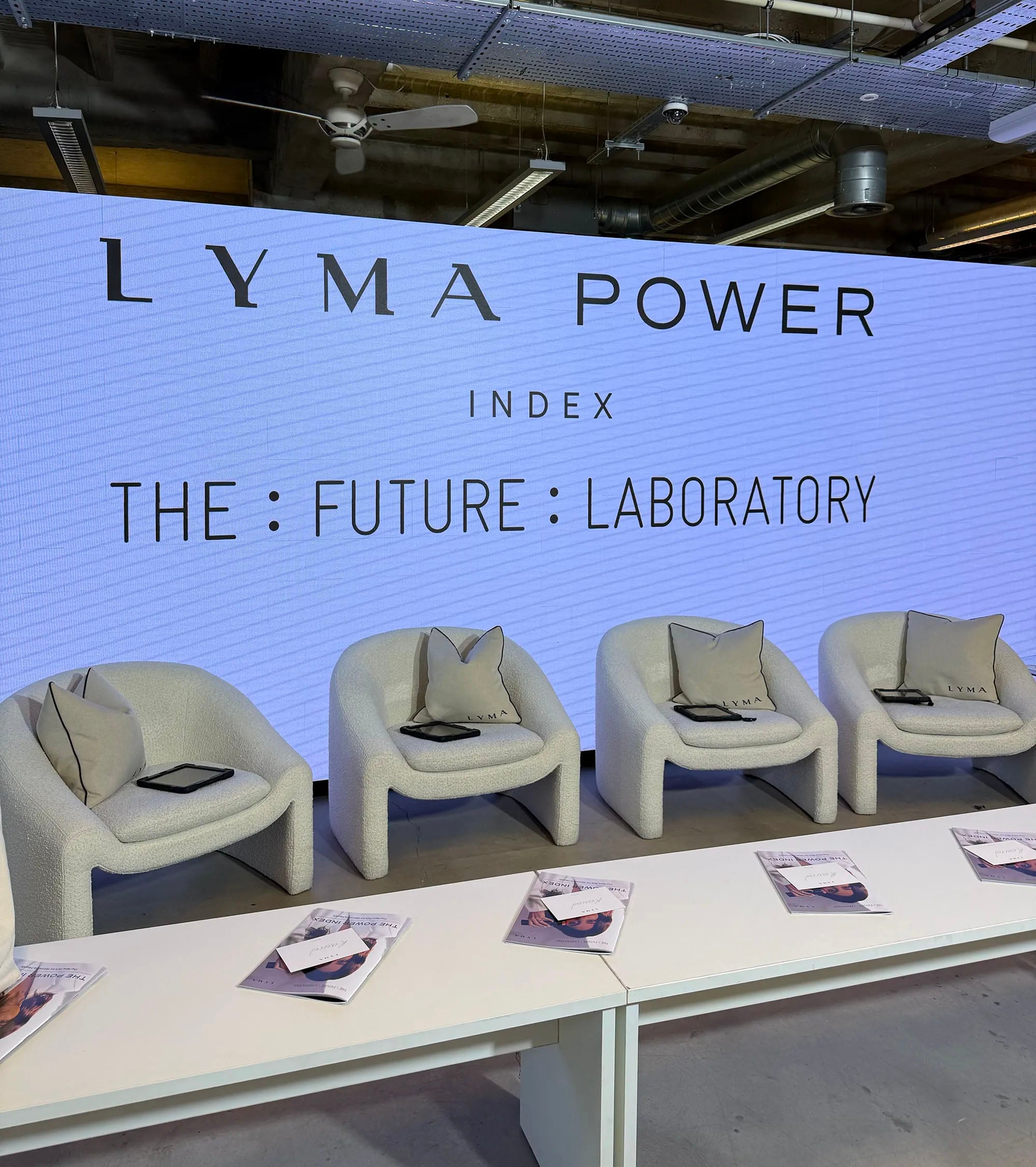 P.O.W.E.R. House, New York
- Category leadership around the emerging shift from wellness spending to long-term health investment
- A distinctive thought-leadership platform that extends LYMA’s authority beyond its own products and categories
- Credibility and cultural relevance through original consumer research, clinical expertise and live industry dialogue
- A proprietary long-term asset that can continue to shape content, communications and conversations about the future of women’s health
Download the report here