

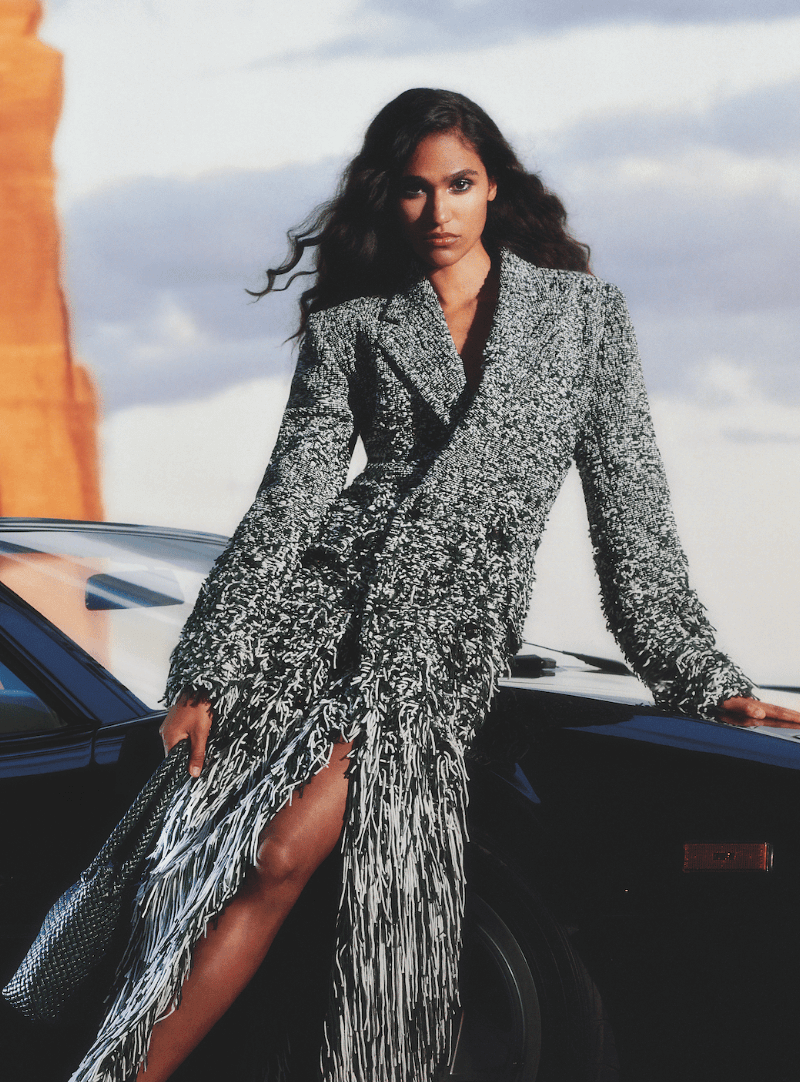
 New Frontiers by Neiman Marcus. Photography by Arnaud Lajeunie, US
This is luxury entering its own liminal moment, wherein its future lies.
The appointment that arrests my attention most is Jonathan Anderson at Dior. Here is a designer becoming the first unified creative director of the house – womenswear, menswear and haute couture – since Christian Dior himself was at the helm. Bernard Arnault, chair of LVMH (Christian Dior’s parent company) has called Anderson ‘one of the greatest creative talents of his generation’ – and placed his bet on a singular vision that reverses decades of divided authority. The man who quadrupled Loewe’s revenue from €230m to €1.07bn now inherits perhaps the most symbolically potent house in French fashion. This is not continuity; this is transformation.
Yet what strikes me most profoundly about this great reshuffle is the paradox of autonomy it reveals. Creative directors today exist in their own uncomfortable liminal space – caught between the imperative to express authentic artistic vision and the relentless commercial pressures of quarterly expectations. Consider Sabato De Sarno, whose two-year tenure at Gucci ended with a poignant Instagram reflection about the challenge of remaining ‘true to yourself’ within such demanding structures. The evaluation timelines imposed by market pressures have become fundamentally incompatible with the patient work of brand-building.
The decades-old tension that sits at the heart of these businesses remain. I remember in the early 2010s hearing the frustrations of a maison CEO who was forbidden from suggesting range additions to the creative director in response to market opportunity – ‘Do you think we could include some handbags in the collection? (pretty please).’ Indeed, the CEO was barred from meeting with the ‘talent’ let alone making commercial suggestions regarding their creative collections.
There’s a troubling bifurcation emerging: a handful of superstar designers – the Andersons, the Blazys - accrue unprecedented creative sovereignty, while others face increasing precarity. When Demna’s appointment at Gucci reportedly erased €3bn in market value overnight, we witnessed something new: creative leadership priced directly into shareholder expectations, with analysis showing 36% negative reaction to the news on social media. The held breath has become a collective financial anxiety.
And so back to the idea of luxury fashion on the threshold of change: the generation inheriting luxury consumption – those values-driven, knowledge-hungry, dupe-happy younger consumers who will make the majority of purchases by 2030 – are scrutinising these appointments through entirely different lenses. They ask not merely ‘What will they design?’ but ‘What do they stand for?’ They evaluate heritage not as static reverence but as living conversation between past and future. For them, transformation must be genuine, not cosmetic.
 AI imagery by The Future Laboratory, UK